

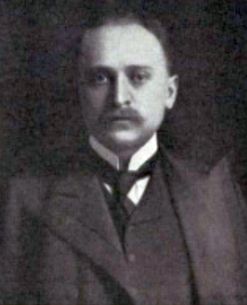
Dr. Richard Haasz

| Born: | 6 October 1872, Szarvas, Hungary |
| Died: | 10 December 1966, St. Petersburg, Florida |
| AKA: | — |
| Labels: | QRS |
Dr Richard Haasz was a Hungarian-American composer-pianist, teacher, and later Cleveland businessman. Trained at Budapest’s Royal/National Academy of Music (often linked in Cleveland notices to Johann Koessler, a Brahms pupil), he also held a doctor juris, was admitted to the Budapest bar, and briefly served as a county-court commissioner before committing his energies to music.
He reached the United States in June 1904 aboard the Kaiser Wilhelm der Grosse (name on the manifest spelt “Haacz,” occupation “lawyer”), returned again on 29 Dec 1904, and settled in Cleveland—opening a piano studio (Bangor Building), teaching (e.g., 380 Pearl St.), and quickly publishing a book of songs, piano pieces, a violin-piano sonata, an orchestral suite, and the song “Those Evening Bells.” Showing a light-classical American crossover, he published Will O’ The Wisp Rag (1911) with C. H. Henderson Music Pub. Co., Corry, Pennsylvania; a tidy, studio-friendly rag marrying period syncopation to conservatory polish. He naturalized as a US citizen on 30 Sept 1914 in Cleveland, having divorced after a short marriage.
As a composer, Haasz wrote in a late-Romantic, songful idiom with clear Hungarian color. Contemporary reviewers said he largely avoided avant-garde harmonic experiment in favor of lucid melody and traditional forms, yet with personal touches—most strikingly in his Concerto Apotheosis, in C minor, whose recurring motive quotes “God Bless Hungary.” His German-text songs were praised for natural line and fine diction.
In performance, Giuseppe Creatore’s band featured his Echoes of Life (1906); a Hotel Statler program (Dec. 8 that year) unveiled the Concerto Apotheosis, and a municipal concert premiered his Hungarian Rhapsodie in 1914. He also embraced the player-piano boom: in early December 1912 he visited the Hotel Statler in Cleveland, where Lee S. Roberts had set up the Melville Clark recording piano as part of a recording tour, and cut many of his own compositions, some of which were issued in the next few months by QRS.
Alongside composing, Haasz ran a succession of Cleveland “office” ventures. A 1914 directory lists Haasz & Komlos Co. (real estate); his 1918 draft card gives Notary Public (self-employed) at 1609 W. 28th St.; the 1920 census records “foreign exchange — own office,” and by 1930 he is an insurance agent—a track that echoes his father Samuel’s profession as a banker.
Family records show his parents in Cleveland by 1910 (Louisa reporting four children, three living), and his mother Louisa died on a visit to Budapest on 22 Feb 1932 (cremated in Vienna; ashes entrusted to Richard). He married again to Mary (b. ~1889, Hungary; U.S. arrival 1922) in 1927; she appears with him in 1930s records and as his widow in 1966.
Haasz moved to St. Petersburg, Florida around 1939 and lived there until his death in 1966, aged 94, remembered locally as a cultivated bridge between Budapest training, Cleveland’s immigrant musical life, and the player-piano era.
