|
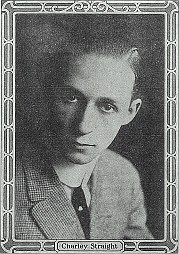
Charles Theodore
Straight was the only son of a saloon keeper and was named after
him. He lost his mother while still an infant, and his father
remarried a few years later. Following his graduation from Wendell
Philips High School in 1909, he entered the world of vaudeville as
the partner of singing-comedian Gene Greene. Their act became a
tremendous success, leading to a series of recordings with various
record companies and touring Europe and Australia. His first
composition, King of the Bungaloos, was a joint effort with
Greene.
In 1913, Straight
married Clara Kennedy, the assistant professional manager of the
Chicago office of Jerome Remick & Co, and worked for Remick
sporadically following their honeymoon in Australia and Europe
accompanying Greene.
Joseph "Wingy" Manone also played
with Straight, and in 1926, Miff Mole and Wild Bill Davison were on a
Brunswick session which produced "Hobo's Prayer"/"Minor Gaff", also
issued on Vocalion Records as by the Tennessee Tooters. Most of
Straight's 1926-27 sides went out on Brunswick under his own name but
some were also issued on Vocalion as the Tuxedo Orchestra. He never
worked as a leader after his last Brunswick sessions of August 1928,
though he is known to have recorded with the Benson Orchestra of
Chicago, run by the agency which handled his own band. They recorded
for Paramount and Brunswick. But, his was not a studio orchestra but a
working one featured at the top hotels and nightclubs in Chicago.
He
remained active as a bandleader until his death in 1940, when he was
hit by a speeding car in Chicago. Bookings for Charley Straight's
Orchestra were slow during late summer of 1940, and Straight had taken
a temporary job as a water sampler for the Sanitary district in
Chicago. It was while working over a manhole on the evening of Sunday
September 22nd that he was struck and killed by a car driven by one
Edward Wehle, a 19 year old residing at 2340
Lincoln Park West. Even though a second job was necessary for Charley
Straight, life was not on the wane - he had one of the fullest Fall
and Winter bookings
in years. The 'Southeast Economist' newspaper reported: "He was
scheduled to appear at numerous South side public and private dances,
but, though his spirit will be there, fate has ruled that Charley
Straight and his inimitable style will be absent."
Straight's funeral was held on Wednesday September 25th at the
Visitation Church. It was large - musicians, song-writers, political
figures were amongst those paying their respects.
|