|
The daughter of
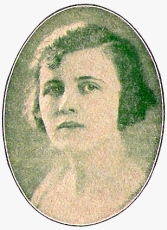
first-generation Americans Emil and Emma Wehmeier, Hilda was an
honour graduate of the College of Music in Cincinnati.
Her father Emil (b. 1863) worked as a harness maker, and married
Emma Pfleiderer (b. 1868), a Kentuckian, in 1894. Both were the
children of German immigrants. Her father was the proprietor of a
cafe around 1910, before returning to his original profession, and
Hilda may have got her start performing for the customers.
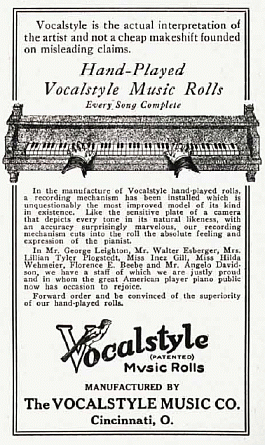
Vocalstyle ceased production of piano
rolls in January 1927 in the wake of falling prices for music rolls
and increased competition. Hilda was there until the end, two of her
last recordings being featured in the December 1926 bulletin - "I'll
Fly To Hawaii" and "Hello Bluebird".
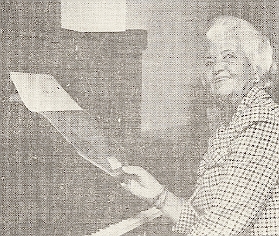
In later years the Myers family lived
at 9 West Hill Lane, Wyoming, Ohio. In a newspaper interview c.
1974, Hilda recalled the Vocalstyle days, estimating she made
400-600 rolls in total and saying the company would send her sheet
music which she would 'work up', and notify them when she was ready
to make a recording. Each hammer of the recording piano was equipped
with a small rubber hose, which ran into the next room and made
marks on the large paper roll. When the recording was finished,
'a battery of girls in the cutting room would hand cut the roll or
perforate it at each mark. That became the master roll'.
She also mentioned she didn't like some of the titles selected for
her to record, but "I'd do the best I could with everything I'd
play". The roll played back for her at the time of the interview
was #12784, You May Be Fast, But Your Mamma's Gonna Slow You
Down", released in April 1924. She failed to recognise the tune
at first, but, as 'the song unreeled on a paper roll in a player
piano, its perforations hitting the keys exactly as Hilda Myers had
recorded it in Cincinnati 50 years before, she shook her head, shut
her eyes as if trying" to erase the recording from memory and
finally smiled. "It's the title," sighed Mrs. Myers, of 119 Forest
Ave., Wyoming. "I never did like that title." The interview also
revealed she had never owned a player piano, and her favourite roll
she had recorded was Mandalay.
Her husband Raymond died at their residence
on 18th February 1962, aged 70. Hilda herself died on 28th March
1985 in Indianapolis, Indiana and was buried on 30th March next to
her husband in Oak Hill Cemetery, Cincinnati.
 |
|